Kinesiology & Active Rehab in Burnaby
Exercise-based rehab to rebuild strength and mobility and get back to work or sport.
Kinesiology at Phoenix Rehab
Kinesiology is the science of human movement, focusing on how the body functions in motion. Kinesiologists are movement professionals who use active, exercise-based therapy to help patients recover from injuries, manage chronic conditions, and improve overall performance.
At Phoenix Rehab, our kinesiologists design customized active rehabilitation programs that include therapeutic exercises, strength training, and education. Whether you're recovering from an accident, managing mobility issues, or working toward injury prevention, kinesiology empowers you to move confidently and stay active.
Our Burnaby clinic integrates kinesiology with physiotherapy, chiropractic, massage therapy, acupuncture, and counselling — all under one roof. This means your kinesiologist can collaborate directly with your other practitioners to ensure your exercise program complements your overall treatment plan and accelerates your recovery.
Registered Kinesiologists (R.Kin)
Certified movement and exercise professionals
ICBC Direct Billing
Approved active rehab programs billed directly
Goal-Focused Programs
Every plan designed around your unique goals
What Conditions Does Kinesiology Support?
Our kinesiology and active rehab programs support a wide range of recovery and performance goals.
Sports Injuries
Recovery programs to restore performance and prevent re-injury after athletic injuries. Your kinesiologist designs sport-specific exercise progressions that address the physical demands of your activity, rebuild confidence in movement, and systematically prepare you for a safe return to play.
Motor Vehicle Accidents (ICBC)
Structured active rehab may support strength and mobility after a car accident. Direct billing may be available through approved ICBC Active Rehab claims.
Work-Related Injuries (WSBC)
Rehabilitation for repetitive strain, lifting injuries, and occupational postural concerns. We work with your employer and WorkSafeBC to design return-to-work programs that match the physical demands of your job, ensuring a safe and sustainable transition back to full duties.
Post-Surgical Recovery
Guided exercise programs after orthopedic or joint surgery to safely regain strength and function. Your kinesiologist follows post-operative protocols while progressively challenging your body to rebuild — from early mobility work through to full functional strength.
Chronic Pain & Mobility Issues
Gentle, progressive programs for arthritis, back pain, and functional limitations that affect daily life. Active rehabilitation helps break the pain-avoidance cycle by gradually reintroducing movement in a safe, supported way — building strength and confidence without aggravating your condition.
Balance & Coordination Deficits
Retraining for improved stability, movement confidence, and fall prevention. Your kinesiologist uses progressively challenging balance exercises, proprioceptive drills, and functional tasks to rebuild the neural pathways that keep you steady and confident on your feet.
General Conditioning & Injury Prevention
Programs to improve overall fitness, posture, and long-term resilience against future injury. Whether you are returning to activity after a period of inactivity or want to build a stronger physical foundation, kinesiology provides the structure and guidance to get there safely.
What Techniques Are Used in Kinesiology?
Our kinesiologists use a range of active, movement-based strategies to promote recovery, build resilience, and optimize long-term health and performance.
Registered Kinesiologists (R.Kin)
Certified by the British Columbia Kinesiology Association (BCAK)
Core Active Rehab
Active Rehabilitation Programs
Exercise plans that rebuild strength, balance, and endurance after injury or surgery.
ICBC Active Rehab
ICBC-approved exercise programs designed specifically for motor vehicle accident recovery.
Strength & Movement
Strength & Conditioning Training
Progressive resistance and functional training matched to your recovery stage and personal goals.
Functional Movement Training
Retraining body mechanics for safe, efficient movement in daily activities and athletic performance.
Education & Prevention
Postural & Ergonomic Coaching
Correcting movement patterns and workplace setups to reduce ongoing strain and prevent re-injury.
Home Exercise Programs
Clear, structured plans so you can continue making progress between clinic sessions at home.
How Does Kinesiology Work?
A structured, progressive approach to help you rebuild strength, restore movement, and maintain lasting results.
Initial Assessment & Goal Setting
Your first session begins with a detailed movement assessment — evaluating your strength, range of motion, balance, posture, and functional capacity. Your kinesiologist discusses your history, current limitations, and personal goals, then creates a customized active rehab plan designed to take you from where you are now to where you want to be.
Guided Exercise Sessions
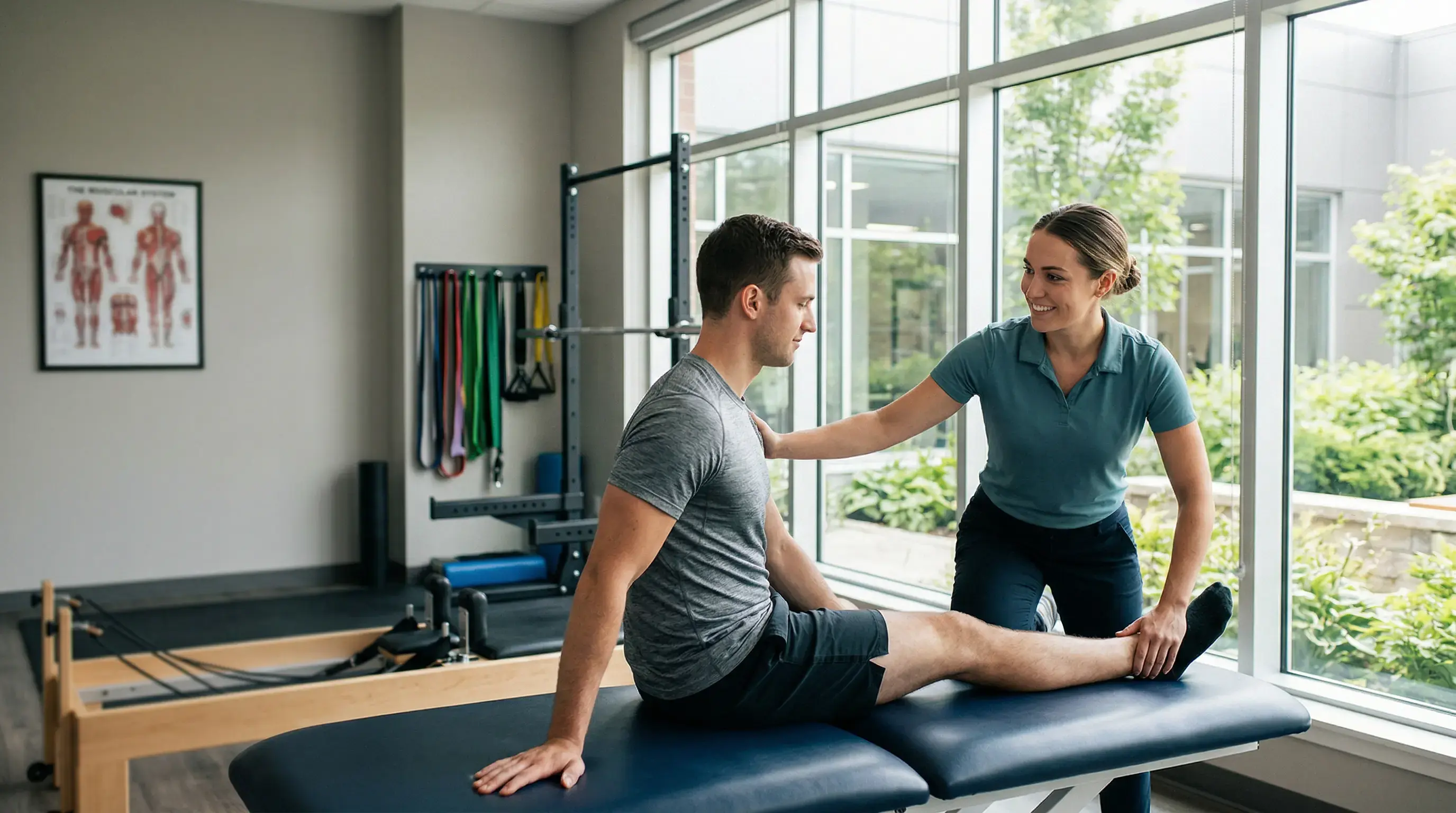
Each one-on-one session is hands-on and active. Your kinesiologist leads you through exercises specifically chosen for your recovery stage, corrects your form in real time, and progressively increases difficulty as you get stronger. Every session is tracked so you can see your improvement over time.
Ongoing Recovery & Long-Term Wellness
As you progress, your kinesiologist provides home exercise programs, self-management education, and lifestyle strategies to help you maintain your gains independently. The goal is not just recovery — it is building long-term resilience so you can stay active, prevent future injuries, and manage your health on your own terms.
Active Rehab at a Glance
Our kinesiologists coordinate exercise-based care alongside the clinic's physiotherapists.
How It Starts
A physiotherapy or doctor referral, or an approved ICBC active rehab claim, is followed by a movement assessment.
Typical Length
ICBC programs typically include 12 to 16 sessions over 8 to 12 weeks.
How Often
The progressive phase typically includes 2 to 3 sessions each week.
One Session
A check-in and warm-up lead into the main exercise block, then a home-plan update.
Re-assessment
We reassess whenever your symptoms change or your progress calls for it.
How It Ends
The program ends with discharge to a home program you can run independently.
What Should You Expect in a Kinesiology Session?
Session Details
Initial assessment sessions typically last 60 minutes. Your kinesiologist performs a full movement screen, discusses your history and goals, and often begins your first exercise program in the same visit so you leave with actionable next steps.
Follow-up sessions are 45–60 minutes of active, supervised exercise. Your kinesiologist guides you through each movement, corrects form, and adjusts intensity based on how your body is responding that day.
Programs combine strength training, mobility work, balance drills, cardiovascular conditioning, and functional movement patterns — carefully selected and progressed based on your specific condition and recovery stage.
You will receive a home exercise plan built for your condition with clear instructions and progressions so you can continue building strength between sessions. Your kinesiologist reviews and updates this plan regularly.
Most patients report noticeable improvement in strength, pain levels, and movement confidence within the first 3–4 weeks. However, lasting recovery takes consistent effort — your kinesiologist helps you set realistic milestones and celebrates your progress along the way.
Who Can Benefit from Kinesiology & Active Rehab?
Kinesiology is for anyone who wants to move better — whether you are recovering from an injury, managing a chronic condition, or looking to build a stronger physical foundation. Here are some of the people we commonly work with at our Burnaby clinic.
Motor Vehicle Accident Survivors (ICBC)
ICBC Active Rehab may support strength, mobility, and confidence after a car accident. Direct billing may be available for approved claims.
Post-Surgical Patients
After orthopedic surgery (knee replacement, ACL reconstruction, shoulder repair, spinal surgery), kinesiology provides the structured, progressive exercise program you need to regain full function. Your kinesiologist works within your surgeon's guidelines while steadily pushing your recovery forward.
People Living with Chronic Pain
If chronic back pain, arthritis, fibromyalgia, or other persistent conditions have made you afraid to move, kinesiology can help. Gentle, graduated exercise programs break the pain-avoidance cycle, rebuild deconditioning, and give you the tools to manage your condition actively rather than passively.
Seniors & Older Adults
Age-related loss of strength, balance, and mobility can be significantly improved with the right exercise program. Kinesiology for seniors focuses on fall prevention, functional independence, joint health, and maintaining the ability to do the things that matter — from walking to gardening to playing with grandchildren.
Athletes & Active Individuals
Whether recovering from a sports injury or looking to prevent one, kinesiology provides sport-specific conditioning, movement analysis, and targeted strengthening. Your kinesiologist understands the demands of your sport and designs programs that get you back to competition-ready safely.
Workers with Occupational Injuries
For WorkSafeBC claims or any workplace injury, kinesiology helps you rebuild the specific physical capacities your job demands. We design return-to-work programs that address the gap between your current ability and your job requirements — gradually bridging it through targeted exercise.
Is Active Rehab the Right Step Now?
Kinesiology is exercise-based care that works alongside our physiotherapists.
Active rehab may be a good fit when you are:
- Cleared for exercise after an assessment
- Starting with an approved ICBC active rehab referral
- After surgery, with your surgeon's clearance
- Managing deconditioning or pain that has lasted months
- An older adult working on balance and strength
Start with physiotherapy first when you have:
- A new injury that has not been assessed
- Pain that is not yet settled
- A concern that still needs a diagnosis
Not sure? Start with an assessment: Physiotherapy in Burnaby
How Long Does Active Rehab Take?
The duration of kinesiology treatment depends on your condition, its severity, your starting fitness level, and your goals. Here is a general guide to help set expectations.
Sessions 1–4: Assessment & Foundation
Your kinesiologist performs a thorough movement assessment and begins a gentle exercise program focused on restoring basic mobility, reducing pain, and establishing safe movement patterns. Most patients begin to feel more confident in their body within the first few sessions.
Weeks 3–10: Progressive Strengthening
As your body adapts, exercises become more challenging — increasing resistance, complexity, and functional demand. This is where the significant gains happen in strength, endurance, and movement quality. Sessions are typically 2–3 times per week during this phase for ICBC active rehab.
Weeks 8–16+: Independence & Maintenance
Your kinesiologist transitions you toward independent exercise — refining your home program, building confidence in self-management, and reducing session frequency. The goal is to equip you with the knowledge and habits to maintain your gains long-term without ongoing supervision.
ICBC Active Rehab programs typically run 12–16 sessions over 8–12 weeks, depending on the severity of your injuries and your rate of progress. Post-surgical recovery timelines vary by procedure but generally require 12–24 weeks of graduated exercise. Chronic pain and deconditioning programs may take longer but produce meaningful improvements within the first month. Your kinesiologist provides a specific treatment plan during your first session and adjusts it based on your progress at every visit.
Kinesiology FAQs
What Is the Difference Between Kinesiology and Physiotherapy?
Physiotherapy focuses on diagnosing movement disorders and using manual techniques (hands-on therapy, modalities, joint mobilization) alongside exercise. Kinesiology focuses specifically on active, exercise-based rehabilitation — your kinesiologist designs and supervises exercise programs to rebuild strength, mobility, and function. The two services complement each other well, and at Phoenix Rehab you can access both under one roof. Many patients work with a physiotherapist for hands-on treatment and a kinesiologist for active rehab concurrently.
Does ICBC Cover Kinesiology?
Yes. If you have been injured in a motor vehicle accident, ICBC may cover Active Rehabilitation provided by a Registered Kinesiologist as part of your accident benefits claim. You will need an ICBC claim number and typically a referral from your physician or treating practitioner. At Phoenix Rehab, we handle all ICBC paperwork and billing directly, so approved programs may have little or no out-of-pocket cost.
Do I Need a Referral to See a Kinesiologist?
For private-pay sessions, no referral is needed — you can book directly. For ICBC Active Rehab, a referral from your physician or treating practitioner (physiotherapist, chiropractor) is typically required to activate your coverage. Our admin team can help you navigate the referral process and confirm what is needed for your specific situation.
What Is ICBC Active Rehab?
ICBC Active Rehab is an exercise-based recovery program after a motor vehicle accident. A kinesiologist may help you rebuild strength and mobility through progressive exercise. Coverage and direct billing may be available for approved claims.
Will I Get a Home Exercise Program?
Yes, always. Home exercise is a critical part of kinesiology treatment. Your kinesiologist provides a written exercise plan built for your condition with clear instructions, sets, reps, and progressions. The plan is updated regularly as you improve. Doing your home exercises consistently between sessions is one of the biggest factors in how quickly and completely you recover.
Do I Need to Be Fit to Start Kinesiology?
No. Kinesiology programs are designed to meet you exactly where you are — whether that is recovering from surgery, managing chronic pain with minimal activity tolerance, or returning to sport after an injury. Your kinesiologist starts at an appropriate level and progresses gradually. Every exercise is adapted to your current ability, and you are never pushed beyond what is safe for your condition.
What Does Kinesiology Cost?
ICBC Active Rehab coverage may be available for approved claims.
Direct billing may be available for approved ICBC Active Rehab claims. Private-pay options are also available.
Have an ICBC claim? Call us at 778-379-9888. We'll help you get started, and approved sessions may have little or no out-of-pocket cost.
ICBC Active Rehab
If injured in a motor vehicle accident, ICBC often covers Active Rehabilitation with a referral. We bill ICBC directly once your program is approved.
Private-Pay Options
For patients without an ICBC claim, kinesiology sessions are available at affordable private rates.
Special Programs & Grants
Some civil servant or employer wellness grants may cover kinesiology sessions. Check with your benefits provider for details.
Meet Your Kinesiology Team
Our kinesiologists design active rehabilitation programs tailored to your recovery goals.
Serving Nearby Neighbourhoods
Phoenix Rehab is on Boundary Road, an easy trip from these Burnaby and East Vancouver neighbourhoods.
Ready to Move Better?
Book a kinesiology session at our Burnaby clinic and take the first step toward stronger movement, reduced pain, and lasting recovery.
100B – 3300 Boundary Rd, Burnaby | 778-379-9888